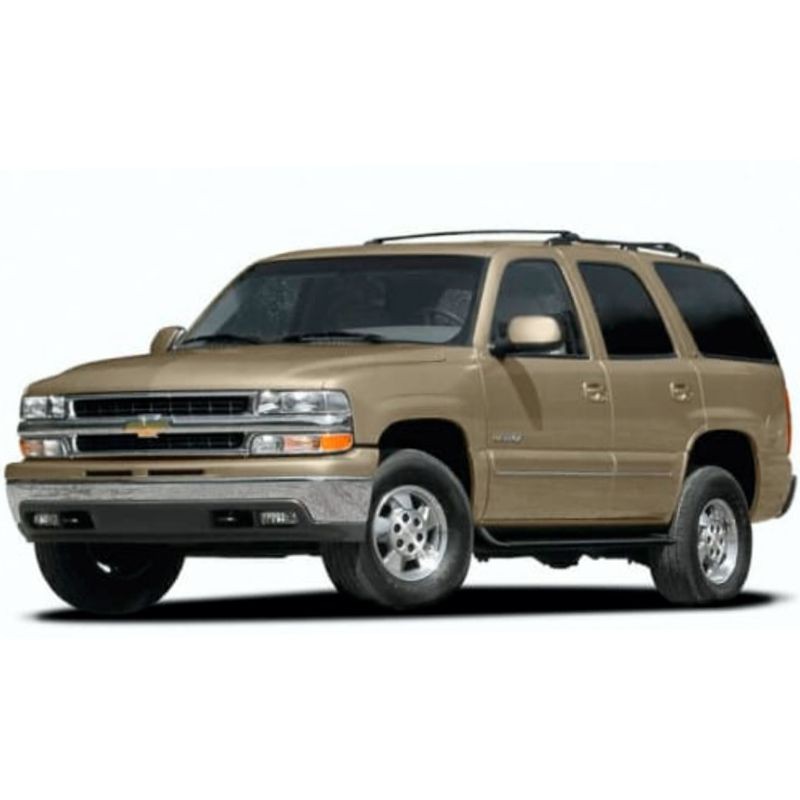
- -$10.00


In practical diagnostics, tracing an intermittent rough idle on a high-mileage 5.3L Vortec often sends techs down a rabbit hole. A common issue technicians encounter is an oxygen sensor (HO2S) code appearing repeatedly on the scanner. You might throw parts at it, but this workshop reference shows you exactly how mechanical realities—like a failing exhaust manifold gasket causing localized leaning, or degrading engine mounts pulling on a ground strap—will skew the PCM’s voltage readings.
When you understand the vehicle's architecture, you stop guessing. This massive 8,691-page digital resource maps out the complete interaction between physical moving parts and the modules that control them.
Let's look at the Tahoe's driveline and automatic level control systems. During troubleshooting, when the 4L60-E automatic transmission starts hunting for gears or shifting harshly, it's extremely easy to assume the internal shift solenoids are fried. However, if the wheel speed sensors are vibrating due to worn mechanical assemblies—like failing driveshaft u-joints or shot wheel bearings—the erratic AC voltage signal forces the transmission into a protective failsafe mode.
This technical document gives you both the mechanical driveshaft runout tolerances and the complete automatic transmission overhaul procedures. In turn, you can reference the dedicated ABS/Traction control wiring circuits to verify if physical vibration is directly triggering the electrical fault. It completely connects the dots between a physical symptom and an electronic module's response.
Tackling major block repairs on the 4.8L, 5.3L, or 6.0L V8 requires absolute precision. One frequent diagnostic mistake is ignoring the strict sequence for head bolt torque during an upper-end rebuild. The Gen III LS-architecture utilizes specific torque-to-yield hardware; if you guess the final yield angle, you will either warp the aluminum cylinder heads or suffer a blown gasket within a few thousand miles.
The engine teardown guide inside this mechanical and electrical repair PDF ensures every specification, from main bearing clearances to valvetrain alignment, is executed to OEM standards. It also deeply covers auxiliary systems, such as the HVAC doors. Often, a dual-zone climate system will throw electrical actuator codes, but the root failure is a mechanically bound blend door inside the dash. By utilizing the specific teardown workflows, you can physically verify the door's movement before ripping into the fuse box layouts or condemning the HVAC control processor.
Flipping through grease-stained, ripped paper books is dead time. Coming in at a massive 1,122 MB, this searchable PDF replaces the entire physical library. If you need the exact connector pinouts for the passenger door module, or need to map the CAN-bus communication lines between the BCM and the instrument cluster, simply search the document. The ultra-high-resolution schematics allow you to zoom in and trace single wire colors and splice locations without losing clarity.
Your bay is tied up; you need specs right now to get the truck out the door. Secure your download via Apple Pay, Google Pay, PayPal, or any major Credit Card.
Upon successful payment, the server instantly fires a download link to your email and drops a persistent copy into your customer account. You get 10 downloads or 10 days to pull this massive 1,122 MB file onto your shop laptop, toughbook, or tablet. Did the shop network time out during the transfer? Don't stress—we’ll spin up a direct Dropbox backup link for you upon request. If you need a quick rundown on handling a file of this size, watch our process here: https://servicemanuals.info/How-to-Download.mp4. Get instant access to the repair manual and stop guessing on your GMT800 repairs.
What causes the automatic level control compressor to run continuously on my 2004 model?
In many real-world repair cases, this isn't an electrical module failure at all, but rather a mechanical air leak in the rear shocks or the pneumatic lines. However, a faulty ride height sensor—often physically damaged by road debris or seized linkage—can also force the relay to stay closed. This guide includes the full pneumatic routing and the sensor voltage testing procedures to isolate the real issue.
Will this resource help me trace a Passlock security system that keeps disabling the fuel injectors?
Yes. You'll find the dedicated immobilization circuits and theft-deterrent module schematics. Crucially, the OEM service instructions explain the interaction between the ignition cylinder's physical rotation and the electrical resistance signal sent to the PCM, helping you identify if the fault is a worn mechanical tumbler or a degraded harness connection.
Are the internal rebuild steps for the 4L65-E included, or is it just removal and replacement?
The data goes deep into the transmission's internals. It contains the complete automatic transmission overhaul section for both the 4L60-E and 4L65-E variants, covering clutch pack clearances, valve body check ball locations, and exact tightening sequences for the pump and casing reassembly.
How do I test the electronic throttle body on the 5.3L to see if it’s causing a dead pedal?
Section 6 covers engine performance circuits extensively. You can cross-reference the throttle position sensor (TPS) sweep voltages against the accelerator pedal position (APP) sensor data to determine if the ECU is receiving mismatched signals, or if the mechanical throttle blade is simply binding due to carbon buildup.